
CPM vs RPM vs CPC vs CTR: Differences, Formulas & When to Use Each (Simple Guide)
If you publish content, run ads, or manage a website, you’ll constantly see four ad metrics: CPM, RPM, CPC, and CTR.
They look similar—but they measure different parts of the ad revenue puzzle.
This guide explains each metric in plain English, shows formulas, includes a comparison table, and gives practical tips so you can make better monetization decisions—especially if you use Google AdSense or other display ad platforms.
If you want to calculate these values instantly, try our tools:
[CPM Calculator] (also includes CPC & CTR calculations) and [RPM Calculator].
What These Metrics Actually Measure (Quick Summary)
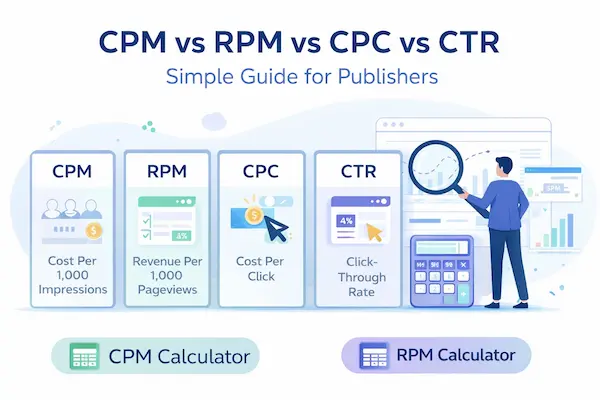
- CPM = How much advertisers pay per 1,000 ad impressions (cost to advertiser).
- RPM = How much you earn per 1,000 pageviews or impressions (revenue to publisher).
- CPC = Earnings (or cost) per ad click.
- CTR = How often people click ads (clicks ÷ impressions).
Think of it like this:
- CTR and CPC influence earnings per click and engagement
- CPM influences value per impression
- RPM is the final “publisher outcome” metric that reflects everything combined
CPM (Cost Per Mille): Meaning, Formula, and When It Matters
What is CPM?
CPM means the cost per 1,000 impressions. It’s primarily an advertiser metric—it tells you how much an advertiser is paying to show their ad 1,000 times.
CPM Formula
CPM = (Total Ad Spend ÷ Total Impressions) × 1,000
When CPM is most useful
CPM is useful when:
- You’re comparing ad demand or seasonality (CPM tends to rise in Q4).
- You want to understand how “valuable” your traffic appears to advertisers.
- You’re working with direct deals or networks that pay per impression.
Calculate CPM quickly here: [CPM Calculator]
What increases CPM?
- High-value countries (US, UK, CA, AU…)
- Strong niche intent (finance, insurance, B2B, SaaS often higher)
- Viewability and user experience quality
- Brand-safe, compliant content
Link to an authoritative page explaining ad auctions / CPM pricing (e.g., Google AdSense Help Center or Google Ads documentation).
RPM (Revenue Per Mille): The Publisher’s Bottom-Line Metric
What is RPM?
RPM is one of the most important metrics for publishers because it tells you how much you earned per 1,000 pageviews (or impressions).
Unlike CPM (advertiser cost), RPM reflects your actual revenue.
RPM Formula
RPM = (Estimated Earnings ÷ Pageviews) × 1,000
Some platforms also show “Ad RPM” vs “Page RPM.”
- Page RPM uses pageviews
- Ad RPM uses ad impressions
Both are useful, but Page RPM is usually the clearest for publishers.
Why RPM matters most
RPM combines multiple factors:
- traffic quality
- CTR (click engagement)
- CPC (click value)
- CPM (impression value)
- ad layout and viewability
- number of ads per page (within policy limits)
Calculate your revenue per 1,000 visits here: [RPM Calculator]
Common RPM misconceptions
My RPM dropped, so my traffic dropped. Not always.
RPM can drop even if traffic stays the same—because CPC, CTR, geography, or advertiser demand changed.
Read more: [Why Is My AdSense RPM Dropping?]
CPC (Cost Per Click): Click Value and Intent
What is CPC?
CPC measures the value of each ad click. For publishers, CPC typically means how much you earn per click (even though the acronym originally describes advertiser cost).
CPC Formula
CPC = Total Earnings ÷ Total Clicks
When CPC is useful
CPC is useful when:
- You want to understand the “quality/value” of clicks.
- You see stable CTR but revenue changes (CPC may be the reason).
- You’re optimizing content for higher-intent visitors.
What increases CPC?
- Strong commercial intent (people ready to buy)
- Valuable niches (finance, software, legal, education, health—varies)
- High-value geos
- Advertiser competition
Link to Google AdSense documentation on earnings factors or ad auction basics.
CTR (Click-Through Rate): Engagement Rate
What is CTR?
CTR measures how often people click an ad after seeing it.
CTR Formula
CTR = (Clicks ÷ Impressions) × 100
When CTR is useful
CTR is useful when:
- You are testing ad placement (top vs middle vs end of content).
- You want to improve engagement without increasing traffic.
- You’re diagnosing why earnings are low (low CTR often means layout mismatch).
What improves CTR (without breaking policies)
- Better ad placement in high-attention areas (not deceptive)
- Fast page speed + good UX
- Relevant content matching user intent
- Mobile-friendly design
Learn CTR properly: [Understanding Click-Through Rate (CTR): An Essential Metric]
CPM vs RPM vs CPC vs CTR (Comparison Table)
| Metric | Measures | Formula | Best For | A “Good” Sign When… |
|---|---|---|---|---|
| CPM | Cost per 1,000 impressions | (Spend ÷ Impressions) × 1000 | Market demand, ad value | Advertisers value your audience |
| RPM | Earnings per 1,000 pageviews | (Earnings ÷ Pageviews) × 1000 | Publisher revenue health | Monetization efficiency is improving |
| CPC | Value per click | Earnings ÷ Clicks | Click quality/value | You attract high-intent visitors |
| CTR | Click frequency | (Clicks ÷ Impressions) × 100 | Ad engagement & placement | Ads are seen and relevant |
Simple Example (Realistic Numbers)
Let’s say your site has in one day:
- Pageviews: 10,000
- Ad impressions: 30,000
- Clicks: 120
- Earnings: $60
Calculate RPM
RPM = (60 ÷ 10,000) × 1,000 = $6.00 RPM
Calculate CPC
CPC = 60 ÷ 120 = $0.50 CPC
Calculate CTR
CTR = (120 ÷ 30,000) × 100 = 0.4% CTR
Now you can interpret it:
- CTR is modest (common for display ads)
- CPC is decent
- RPM is your headline performance metric
Which Metric Should You Focus On?
If you’re a publisher (most likely):
✅ Focus on RPM as your main KPI
Then use CPC/CTR/CPM to diagnose what’s driving it.
If you’re selling impressions or doing brand campaigns:
✅ CPM is more central
If you’re testing layouts and content engagement:
✅ CTR is your first signal
If revenue changes but traffic doesn’t:
✅ Check CPC + geography + seasonality
- [What Are Advertising Metrics? A Complete Guide for Publishers]
- [What Is RPM in Google AdSense? Meaning & Explained]
- [What Is CPM? The Complete Guide to Cost Per Mille]
- [Why Is My AdSense RPM Dropping?]
- [Advertising Metrics Blog]
Is RPM the same as CPM?
No. CPM is advertiser cost per 1,000 impressions, while RPM is your earnings per 1,000 pageviews (publisher revenue).
Why is my RPM dropping?
Common reasons: changes in CPC, geography, seasonality, ad demand, user behavior, or policy/coverage limitations.
What’s more important: CTR or CPC?
Both. Higher CTR increases clicks; higher CPC increases value per click. RPM reflects the combined outcome.